ENTERPRISE PROJECT
Enterprise Code Migration
A hybrid migration automation solution combining rule-based Python processing with LLM-powered code generation to modernize legacy enterprise integration workflows.
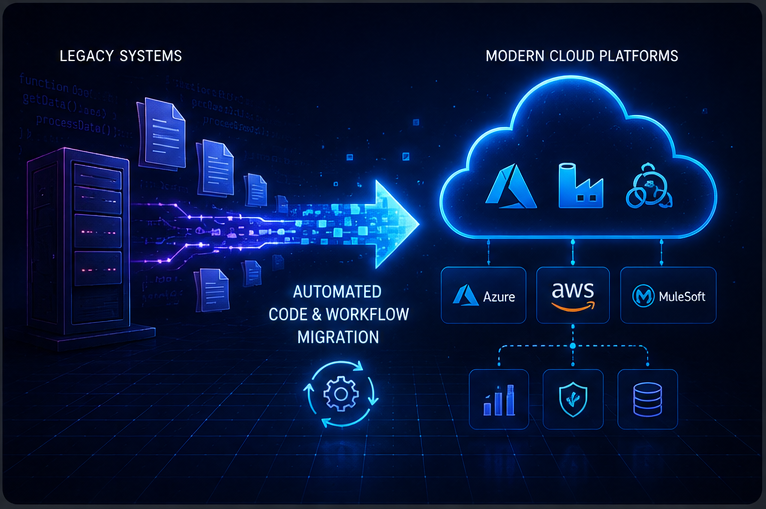
PROJECT OVERVIEW
Automating legacy integration modernization.
Enterprise migration projects traditionally require developers to manually understand legacy workflows, recreate individual components and assemble them into equivalent workflows on a modern platform.
This solution follows a hybrid approach. Rule-based Python logic handles deterministic workflow processing, while LLMs are used for semantic code generation where traditional transformation rules are difficult to maintain.
RULE-BASED
Component Processing
Python-based processing extracts components and reconstructs the logical structure of legacy workflows.
GENERATIVE AI
Code Generation
Prompt engineering and LLMs generate target-platform code for individual migration components.
VALIDATION
Review & Gap Detection
Generated output is reviewed to identify migration gaps and scenarios requiring developer intervention.
MIGRATION PIPELINE
How the migration system works.
The pipeline separates deterministic workflow processing from AI-powered code generation and uses the reconstructed workflow again during final assembly.
SOURCE
Legacy Workflow
BizTalk or TIBCO BW6 workflow definitions containing enterprise integration logic and component relationships.
RULE-BASED PYTHON
Component Extraction
Parses the legacy definition and identifies individual components, configuration details and workflow relationships.
RULE-BASED PYTHON
Logical Workflow Construction
Reconstructs the sequence and relationships between extracted components to create a logical representation of the original workflow.
AI INPUT PREPARATION
Prepare Context for Code Generation
Two pieces of information are prepared for the LLM: the extracted component context and the logical workflow that provides structural information.
INPUT
Component Context
Component type, properties, source logic and transformation requirements extracted from the legacy workflow.
REFERENCE
Logical Workflow
The workflow structure created during the previous stage, used to provide context for correct component generation and later assembly.
LLM + PROMPT ENGINEERING
Component Code Generation
Engineered prompts combine component-specific information with the required target-platform rules to generate the corresponding target code.
GENERATED COMPONENTS
Target Components
Individual target-platform components generated by the LLM are collected for the final workflow assembly stage.
RULE-BASED PYTHON
Workflow Assembly
Generated components are assembled according to the logical workflow created during the extraction stage.
VALIDATION
Validate & Review
Reviews the generated output and identifies migration gaps, unsupported patterns and areas requiring manual developer intervention.
OUTPUT
Target Platform Workflow
An assembled target-platform workflow with generated components and identified migration gaps available for further review.
ENGINEERING APPROACH
Why a hybrid approach?
The system does not rely entirely on Generative AI. Each part of the migration pipeline uses the technique that is best suited to the problem.
Rule-Based Automation
Used for deterministic operations where predictable behaviour is important.
- • Component extraction
- • Workflow reconstruction
- • Component organization
- • Workflow assembly
LLM-Based Generation
Used for semantic translation where legacy and target platforms have different implementation patterns.
- • Component code generation
- • Prompt engineering
- • Target-platform transformation
- • Handling complex transformation logic
MIGRATION APPLICATIONS
Applied across enterprise integration platforms.
MIGRATION 01
BizTalk → Azure Data Factory
Developed a Python-based transformation engine to automate migration of BizTalk workflows into Azure Data Factory implementations.
The solution combined deterministic component extraction and workflow construction with LLM-powered generation of target-platform code.
MIGRATION ACCURACY
~70%
EFFORT REDUCTION
~80%
MIGRATION 02
TIBCO BW6 → MuleSoft
Developed Python and Java-based automation to support migration of TIBCO BusinessWorks workflows into MuleSoft implementations.
The automation combined structured workflow processing with generated target-platform code to reduce repetitive manual development.
TRANSFORMATION ACCURACY
~65%
TIME REDUCTION
~70%
ENGINEERING CHALLENGES
Problems solved by the architecture.
CHALLENGE 01
Preserving workflow structure
Individual component migration is not sufficient because relationships and execution order also need to be preserved.
APPROACH
A rule-based Python stage reconstructs the logical workflow and keeps it available for final assembly.
CHALLENGE 02
Platform-specific transformation
Legacy and target integration platforms expose different constructs and implementation patterns.
APPROACH
LLM-based generation translates component logic into target-platform implementations using structured prompts and context.
CHALLENGE 03
Incomplete generated output
Generated code may not fully support every legacy pattern or platform-specific scenario.
APPROACH
A validation and review stage identifies migration gaps and highlights cases requiring developer intervention.
CHALLENGE 04
Correct workflow assembly
Independently generated components must still be placed in the correct overall workflow structure.
APPROACH
Rule-based Python assembly reconstructs the final workflow using the logical workflow created earlier.
IMPACT
Reducing manual effort in enterprise modernization.
The hybrid architecture automated significant portions of repetitive migration work while retaining deterministic control over workflow structure and human review for migration exceptions.
~70%
BizTalk → ADF migration accuracy
~80%
Developer effort reduction
~65%
TIBCO → MuleSoft transformation accuracy
~70%
Manual development time reduction
TECHNOLOGY