PROJECT
Intelligent Data Parser
An intelligent data-processing system that uses Generative AI to understand different file formats, dynamically generate processing logic and transform unstructured inputs into structured data.
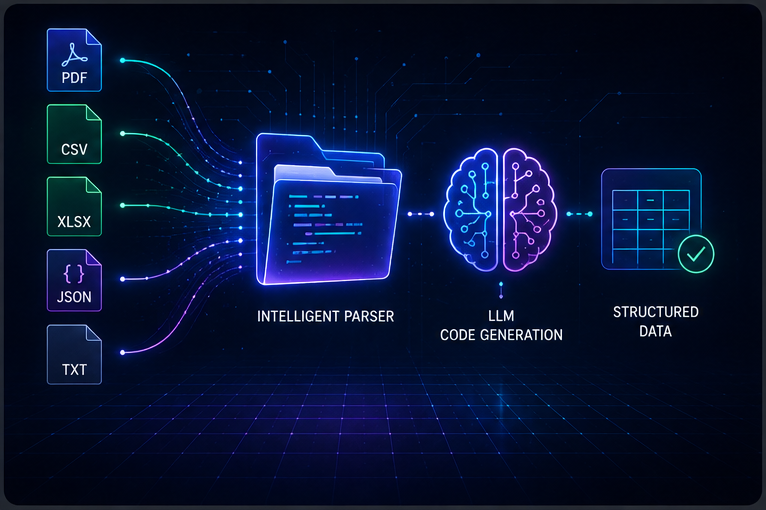
SYSTEM ARCHITECTURE
From raw files to structured data.
Instead of building a separate parser for every file format, the system uses an LLM to understand the input and dynamically generate the processing logic required for the data.
INPUT
Source Files
TXT • CSV • Excel • EDI
PROCESSING
File Understanding
Identifies the file structure and determines how the input should be processed.
GENERATIVE AI
LLM Code Generation
Generates processing logic based on the structure and requirements of the input data.
EXECUTION
Code Execution
Executes the generated processing logic against the input data.
OUTPUT
Structured Data
Processed data ready for downstream systems.
THE PROBLEM
Every format needs different processing logic.
Enterprise workflows often receive data in different formats, including text files, spreadsheets, CSV files and structured exchange formats.
Traditional solutions typically require developers to build and maintain separate parsing logic for each format and variation.
The goal of this project was to make the processing layer more dynamic by allowing an LLM to understand the incoming data and generate the required transformation logic.
HOW IT WORKS
Dynamic processing instead of hard-coded parsers.
The system determines how the incoming data should be processed and uses Generative AI to produce the required transformation logic.
Receive Input
The system receives a supported input file and begins processing the available data.
Understand the Data
The system determines the structure and characteristics of the input required for processing.
Generate Processing Logic
The LLM generates code capable of transforming the input according to the required processing logic.
Execute
The generated processing logic is executed against the input data.
Produce Structured Output
The processed information is transformed into structured data that can be consumed by downstream systems or applications.
ENGINEERING CHALLENGES
Making data processing more adaptable.
Supporting multiple file formats
Different input formats require different approaches to reading and interpreting their contents.
Dynamic file processing
The system is designed around dynamic processing rather than maintaining completely separate transformation workflows for every input type.
Generating transformation logic dynamically
Hard-coded transformation logic becomes difficult to maintain when input structures change.
LLM-based code generation
The LLM generates processing code based on the available input information and transformation requirements.
Converting generated logic into usable output
Generating code is only useful when the resulting transformation can be executed against the actual data.
Generation + execution pipeline
The generated processing logic is passed into an execution stage that applies the transformation to the input data.
TECHNOLOGY
Technology stack
KEY ENGINEERING IDEA
Turning Generative AI into a data-processing engine.
The project goes beyond using an LLM for text generation. The model becomes part of an execution pipeline where it dynamically produces processing logic that can be applied to incoming data.