FEATURED PROJECT
Multi-Agentic Chatbot
A multi-agent conversational system that dynamically routes user requests between specialized RAG and SQL agents for knowledge retrieval and structured-data analysis.
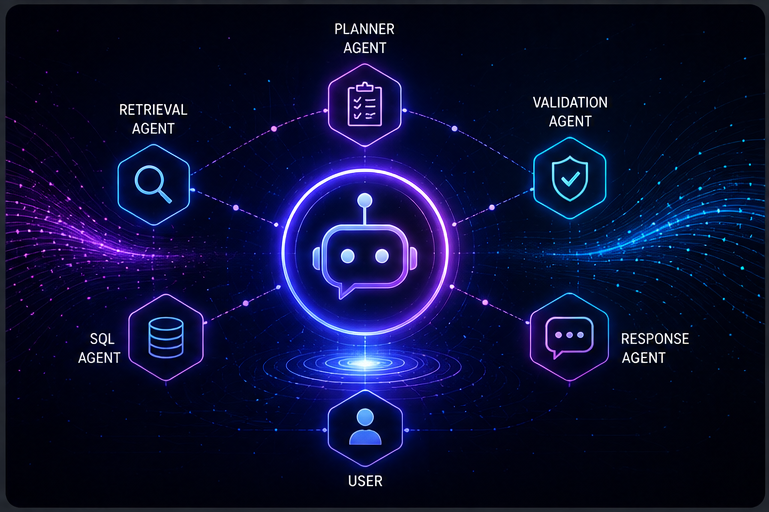
SYSTEM ARCHITECTURE
A multi-agent workflow for intelligent query routing.
The system analyzes each request, routes it to specialized agents, combines their results and generates a final response.
INPUT
User Query
Natural-language request
AGENT 01
Planner Agent
Understands the request and determines the required workflow.
ORCHESTRATION
Orchestrator
Routes the request to the appropriate specialized agents.
AGENT 02
RAG Agent
Handles knowledge-based questions by retrieving relevant contextual information from the knowledge source.
AGENT 03
SQL Agent
Handles structured-data questions by querying the connected database and returning relevant results.
SHARED WORKFLOW CONTEXT
Results from the specialized agents are carried forward through the workflow for final response generation.
AGENT 04
Response Generation Agent
Combines the available context and intermediate results to generate the final natural-language response.
OUTPUT
Final Response
HOW IT WORKS
One query, multiple sources of intelligence.
A single user request can require information from both unstructured knowledge sources and structured databases. The multi-agent workflow determines what information is required, retrieves it and combines the results into one response.
EXAMPLE USER QUERY
"What are the company's safety policies and how many incidents occurred last quarter?"
AGENT PROCESSING
Planner Agent
Identifies that the request contains two different information requirements: policy information and structured incident data.
Orchestrator
Routes the relevant parts of the request to the specialized RAG and SQL agents.
RAG AGENT
Retrieves policy information
Searches the knowledge source for relevant safety policies and returns the retrieved context.
SQL AGENT
Analyzes incident data
Queries the structured database to determine the number of incidents during the requested period.
Response Generation Agent
Combines the retrieved policy context and database results to generate a single coherent response.
FINAL RESPONSE
The system combines the relevant knowledge retrieved by the RAG agent with the structured results returned by the SQL agent and produces a unified natural-language response.
THE PROBLEM
Different questions require different sources.
A conversational system may receive questions that require completely different types of information. Some requests require retrieving information from documents, while others require querying structured data stored in a database.
Handling every type of request through a single workflow can make the system difficult to maintain and extend as new capabilities are introduced.
The solution was to separate responsibilities into specialized agents and coordinate them through an orchestration layer.
ARCHITECTURE COMPONENTS
Specialized agents with focused responsibilities.
Each component performs a focused responsibility while the orchestration layer coordinates the overall workflow.
Planner Agent
Analyzes the incoming request and determines the type of information and processing required.
Orchestrator
Coordinates the workflow and manages the routing of requests between specialized agents.
RAG Agent
Retrieves relevant contextual information from the knowledge source for knowledge-based questions.
SQL Agent
Interacts with structured database information to answer data-oriented questions.
Response Generation Agent
Combines the available context and intermediate results from the workflow to generate the final natural-language response.
REQUEST FLOW
From natural language to a contextual answer.
The workflow separates planning, retrieval, structured-data analysis and response generation into distinct stages.
User Query
The user submits a natural-language request.
Planning
The planner analyzes the request and determines the required processing.
Routing
The orchestrator routes the request to the appropriate specialized agent.
Agent Processing
The RAG and SQL agents retrieve the relevant unstructured and structured information.
Response Generation
The response generation agent combines the available context and produces the final answer.
ENGINEERING CHALLENGES
Designing the system around the problem.
Building a multi-agent system introduced challenges around query routing, specialized processing and combining information from different sources into a single response.
Routing different types of questions
User requests can require completely different sources of information and processing strategies.
Planner + Orchestrator
The planner analyzes the request while the orchestrator controls the workflow and routes it toward the appropriate specialized agent.
Handling unstructured knowledge
Questions based on documents or other knowledge sources require contextual retrieval before generating an answer.
Dedicated RAG Agent
A specialized RAG agent handles knowledge-oriented queries and provides relevant retrieved context to the workflow.
Querying structured business data
Database questions require structured querying and access to the underlying relational data.
Dedicated SQL Agent
The SQL agent handles structured-data requests and retrieves the required information from the connected MySQL database.
Combining information from multiple agents
A complex request may require information produced by more than one specialized agent.
Shared workflow context
Intermediate results from the specialized agents are carried through the workflow so they can be used by subsequent stages.
Producing one coherent answer
Results from different processing paths need to be transformed into a single natural-language response.
Response Generation Agent
A dedicated response-generation stage consumes the available context and produces the final conversational response.
TECHNOLOGY
Technology stack
KEY ENGINEERING IDEA
Specialized intelligence coordinated through a shared workflow.
Instead of relying on a single agent to handle every type of request, the system separates knowledge retrieval and structured-data analysis into specialized agents. Their intermediate results are then made available to the response generation agent, which produces the final answer.